Rodrigues
At 1.5 hours by plane from Mauritius, 18 km long with a lagoon twice the size of the island itself: Rodrigues maintains a rural pace that the larger island has lost.
Rodrigues lies 650 kilometers east of Mauritius, a 1.5-hour flight from Plaisance with Air Mauritius. The island measures 18 kilometers from east to west, 8 from north to south, and peaks at 398 meters at Mont Limon. Its population of roughly 43,000 is descended primarily from freed African and Malagasy slaves of the 19th century. Rodriguian Creole is more pronounced here than in Mauritius, with the economy rooted in lagoon fishing, goat herding, subsistence farming, honey production, and deliberately restrained tourism.
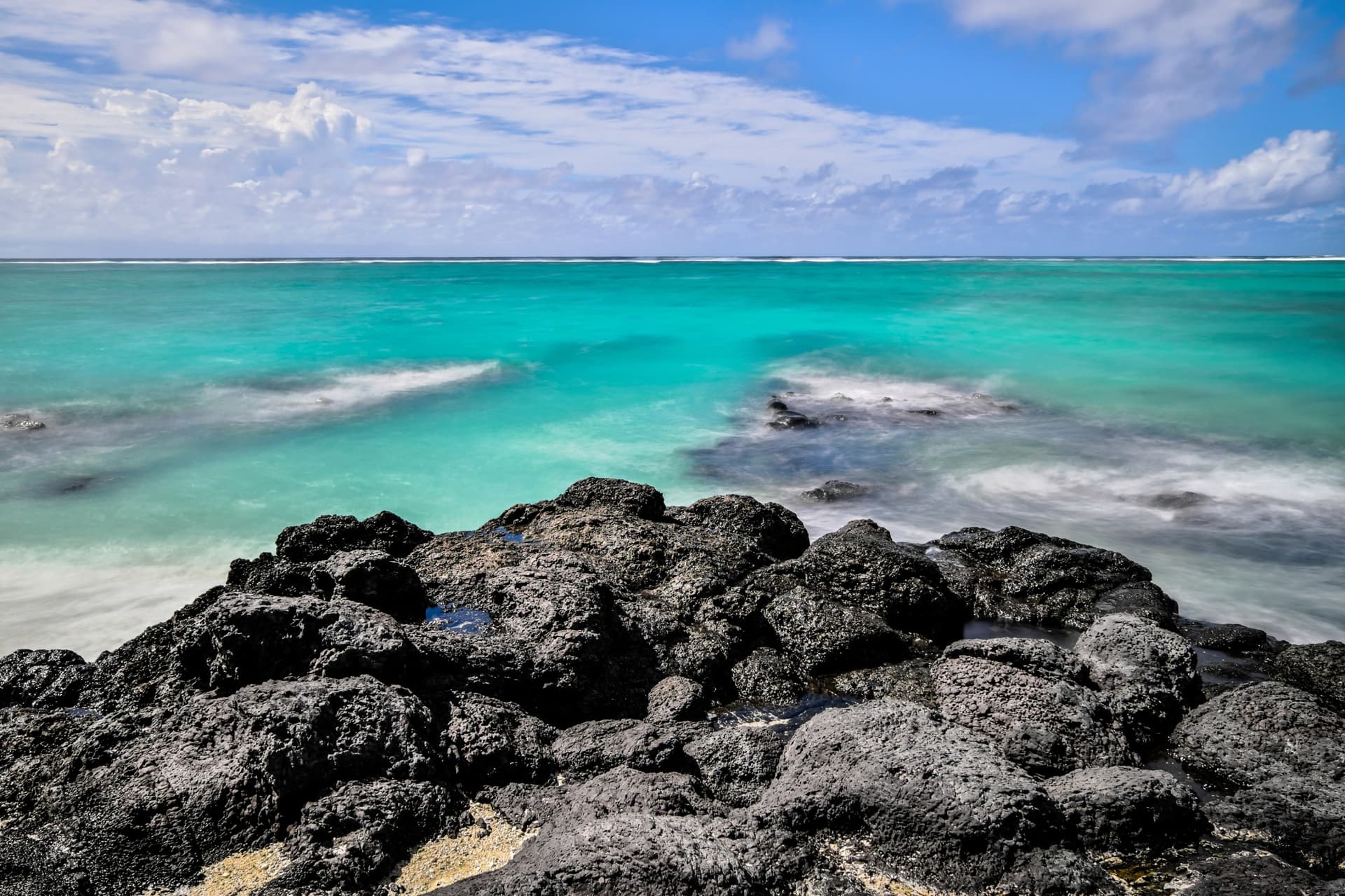
The island is ringed by a lagoon of 240 km², nearly twice its land area. This geographic particularity shapes every aspect of life: women have fished for octopus at low tide for generations, a technique now recognized as part of the island's cultural heritage. The coral barrier, stretching up to 8 kilometers offshore in places, shelters shallow waters where you can wade calf-deep for hundreds of meters.
Port Mathurin, the capital, has roughly 6,000 inhabitants. Its Saturday morning market, from 6 a.m. to 11 a.m., is the island's weekly gathering place: dried octopus hanging from lines, peppers preserved in salvaged jars, eucalyptus honey, sweet potato cakes, green papaya pickles. Herders descend from the heights of Mont Lubin and Saint-Gabriel to sell live goats and poultry. It's also the only moment when the island concentrates crowds; the rest of the week maintains a rural rhythm.
The landscapes read in two tiers. The central plateau, around Mont Lubin and Citronnelle, presents rolling terrain covered in pasture, eucalyptus, and small plots of maize, cassava, and beans. The coast alternates between basalt cliffs to the south (Graviers, Saint-François) and beaches to the north and east (Anse Ally, Trou d'Argent, Saint-François). Caverne Patate, on the southwest coast, is a karstic network of 700 meters of limestone galleries, visitable with a guide in roughly an hour.
Rodriguian cuisine stands distinctly apart from Mauritian fare. More rustic, less Indianized, it centers on maize (maize briani, maize kanon), octopus (octopus curry, octopus salad), goat, and lagoon fish. Women's cooperatives in Saint-François and Rivière Cocos serve meals in family cottages by reservation, at rates around 500 to 700 rupees per person. Local spiced rum, often infused with honey and lime, accompanies these lunches.
Île aux Cocos, a nature reserve west of the lagoon, shelters colonies of sooty terns and noddies. The pirogue crossing from Pointe Cotton or Pointe la Gueule takes roughly 45 minutes and operates under a daily visitor quota to protect the bird populations. To the east, the François Leguat reserve maintains several hundred giant tortoises that have been reintroduced to replace the endemic species that went extinct in the 18th century.
Must-see
Saturday market at Port Mathurin. From 6 a.m. to 11 a.m., dried octopus, preserved peppers, and eucalyptus honey trade hands between herders down from the plateau and capital dwellers. The only weekly moment when the island gathers.
Crossing to Île aux Cocos. 45 minutes by pirogue from Pointe la Gueule to a sandy islet populated by sooty terns. Daily visitor quota; access only with an authorized operator.
Lunch at a Saint-François cooperative. Octopus curry, maize briani, and pickles served in family cottages run by collectives of fisherwoman. Reserve the day before; expect 500 to 700 rupees per person.
Mont Limon hike. The highest point at 398 meters, reached in 40 minutes from Mont Lubin village. A 360° view over the lagoon, agricultural valleys, and the coral barrier offshore.
Caverne Patate and the southern coast. A karstic network of 700 meters of limestone galleries visitable in an hour, followed by a descent to the basalt cliffs of Graviers and Trou d'Argent beach accessible on foot.
When to go
The dry season from May to November offers the most stable conditions: temperatures between 20 and 26°C, steady trade winds, light rainfall. July and August remain cool in the evening on the plateau, around 17°C; bring a fleece. The warm season from December to April sees temperatures climb to 28–31°C with strong humidity and brief but intense showers. January to March aligns with the southwest Indian Ocean cyclone season, with Rodrigues often more exposed than Mauritius due to its easterly position.
For swimming and snorkeling in the lagoon, September through December combines water at 24–26°C, good visibility, and moderate winds. Kitesurfing enthusiasts prefer June to September, when trade winds blow regularly at 20–25 knots across Saint-François Bay.
Practical advice
Three to four nights suffice to grasp Rodrigues' spirit: one day in Port Mathurin and its market, one day on Île aux Cocos, one day of hiking and the Saint-François market, one free day for the lagoon or southern coast. Beyond five nights, the rhythm suits primarily the contemplative and those drawn to fishing. Access is by plane only from Plaisance, with two to three daily Air Mauritius flights; booking is advised three months ahead in high season.
Rodrigues naturally pairs as an extension to a Mauritian stay, never as a sole destination for a first visit. Accommodation is limited to around thirty small properties, mainly at Pointe Cotton, Mourouk, and around Port Mathurin, in the 3-star category or as guest houses. No large resorts, no international chains. The island suits travelers seeking rural authenticity, hiking enthusiasts, families with children old enough for pirogue crossings, and couples wanting contrast after the West Coast or North and Grand Baie. Our English-speaking team in Mauritius organizes the round-trip and on-the-ground logistics with our Rodriguian partners.