Land of Seven Colours
Land of Seven Colours
Geological site at Chamarel where dunes display a palette from ochre to violet, resulting from volcanic decomposition. Trail, Aldabra tortoises and nearby waterfalls.
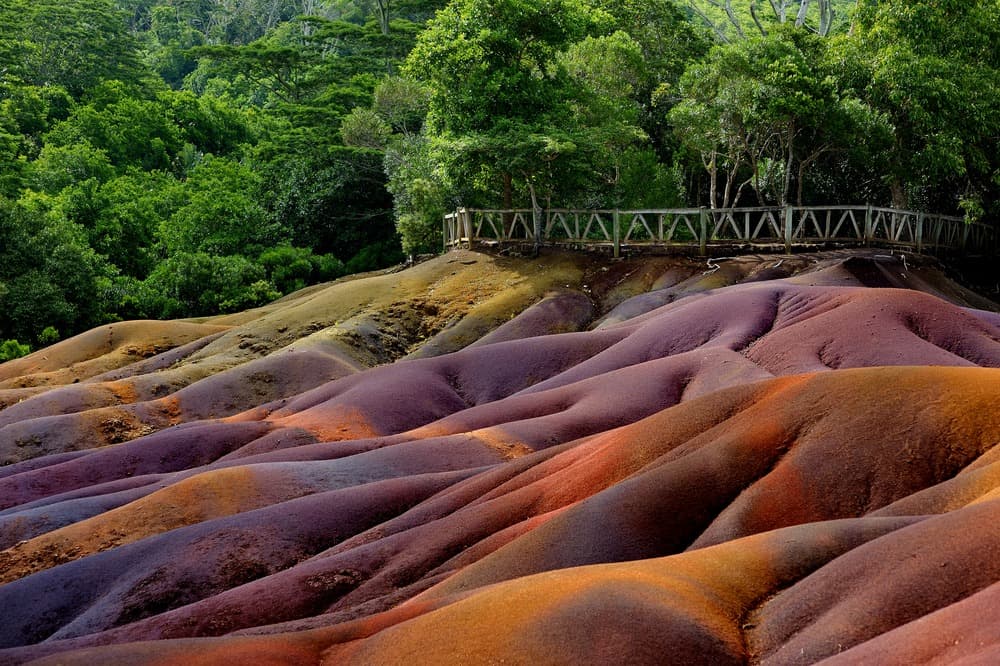
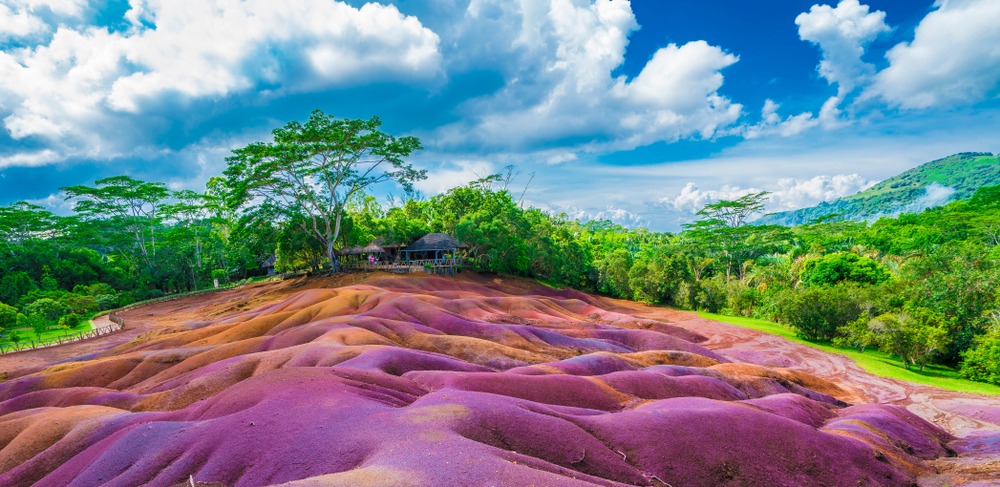
The Land of Seven Colours is a geological site located at Chamarel, in the Rivière Noire district, in the south-west of Mauritius. Over a small area, rippling dunes display a palette of hues ranging from ochre to violet, the result of volcanic decomposition spanning hundreds of millions of years. The site can be explored via a marked trail alongside a park home to giant tortoises.
Why visit the Land of Seven Colours
The site combines three complementary interests: a rare geological curiosity (stable multicoloured sands), a wildlife park dedicated to Aldabra tortoises and direct access to the overlook of Chamarel Falls. The visit is brief — allow 1 to 2 hours on site — but fits easily into a day exploring the south-west of the island, alongside the village of Chamarel and the Le Morne coast.
History of the site
The Royal Society of Arts and Sciences of Mauritius formally becomes aware of the existence of the coloured lands during its session on 26 November 1879, through one of its members. The neighbouring village takes its name from Toussaint and Charles de Chazal de Chamarel, sons-in-law of François de Chazal de la Genesté, then a member of Mauritius's Superior Council. The family had acquired a concession of approximately 213 hectares in the region in 1786.
The site remains little known for a long time before attracting the first adventurers from the 1960s onwards, when tourism began to develop on the island. It is now operated as a geopark, with marked trail, viewpoints and visitor facilities.
Geological origin of the colours
The phenomenon is explained by the slow decomposition of basalt and volcanic lava into clay minerals, over hundreds of millions of years. The island's tropical climate led to the gradual dissolution of silicon dioxide, leaving behind metal oxides responsible for the colouration:
- Iron: scarlet, red and orange hues
- Aluminium oxides: blue to violet shades
- Temperature variations during the cooling of molten rock: other intermediate shades (ochre, fawn, brown)
Notable feature: the colours never mix, even after heavy rainfall. Each pigment returns to its original layer, a behaviour linked to the different density of mineral particles.
What to see on site
The multicoloured dunes
The main attraction occupies a restricted area. A marked trail runs alongside the dunes and offers several viewpoints. Ochre and orange hues dominate, interspersed with fawn and violet zones. The raking light of morning or late afternoon accentuates the contrast between the bands.
The giant tortoise park
Below the site, enclosures house Aldabra tortoises, a species reintroduced after the local population was decimated by poaching. Adults weigh on average 250 kg and can live over 150 years.
Chamarel Falls
On the access route, approximately 3 km beyond the entrance barrier, an overlook on the left allows you to observe Chamarel Falls. The flow is moderate but the rocky amphitheatre into which the water plunges merits a stop.
Practical information
- Location: Rivière Noire district, south-west of the island, just minutes from the village of Chamarel
- Duration of visit: 1 to 2 hours for the site and tortoise park
- Access: open year-round, ticket office on site, moderate charge (adult/child rates)
- Services: restaurant-snack and souvenir shop on site
Prices and opening hours change: verify current information before your visit.
When to visit
The site can be visited year-round, but two time slots are recommended:
- Early in the morning, shortly after opening, for soft light that reveals colour contrasts and a site that is not yet crowded
- Late in the afternoon, when the raking light of the setting sun intensifies the red and violet pigments
Avoid if possible the central hours of the day, when overhead light flattens the colours. In overcast weather, the contrast remains reasonable but less spectacular.
How to get there
Access is by road from the south-west of the island. From Le Morne, allow approximately 30 minutes by car. As you approach the site, you pass through an entrance barrier (geopark toll) then take a rough road of a few kilometres, lined with vetiver grass and coffee plants. A standard rental car is sufficient; traffic moves at a crawl on the track.
No public transport goes directly to the site. Common options are a rental car, a day taxi or an organised excursion combining Chamarel, the Rum Distillery and Black River Gorges.
Nearby
- Chamarel Falls: on the access route, approximately 3 km beyond the entrance barrier
- Curious Corner of Chamarel: optical illusion museum recognisable by the car embedded in its wall, with around forty interactive exhibits
- Chamarel Rum Distillery: guided tour of the local rum-making process, from sugar cane to distillation, with tasting
- Le Morne Brabant: mountain listed by UNESCO, about thirty minutes' drive away
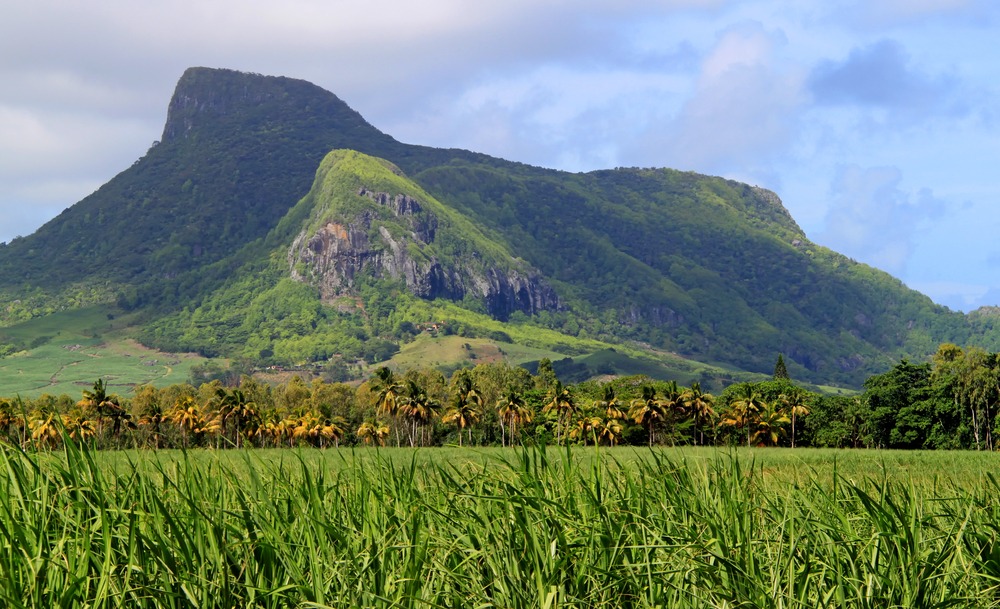
- Lion Mountain: another emblematic landmark of the island, in the south-east
Frequently asked questions
Frequently asked questions
Allow 1 to 2 hours to walk the dunes trail, observe the Aldabra tortoises and stop at the Chamarel Falls overlook. Half a day if you include the Rum Distillery and Curious Corner.
The colouration stems from the decomposition of volcanic basalt over hundreds of millions of years. Iron gives the red hues, aluminium oxides the violet shades, and temperature variations during the cooling of lava explain the other tones.
No. Even after heavy rainfall, each pigment redeposits in its original layer. The colour bands remain distinct, which is what makes the site unique.
Yes. The trail is short and easy, and the tortoise park appeals to children. Reduced rates apply to young visitors.
Early in the morning or late in the afternoon, when raking light intensifies the contrasts. Central hours should be avoided for photography.
Include Chamarel in your trip
The Land of Seven Colours fits naturally into a south-west Mauritian itinerary, between Le Morne, Black River Gorges and the west coast. To build a bespoke itinerary including this stop, consult our journeys to Mauritius.
Interested in this visit?
We can include it in your personalised itinerary.